
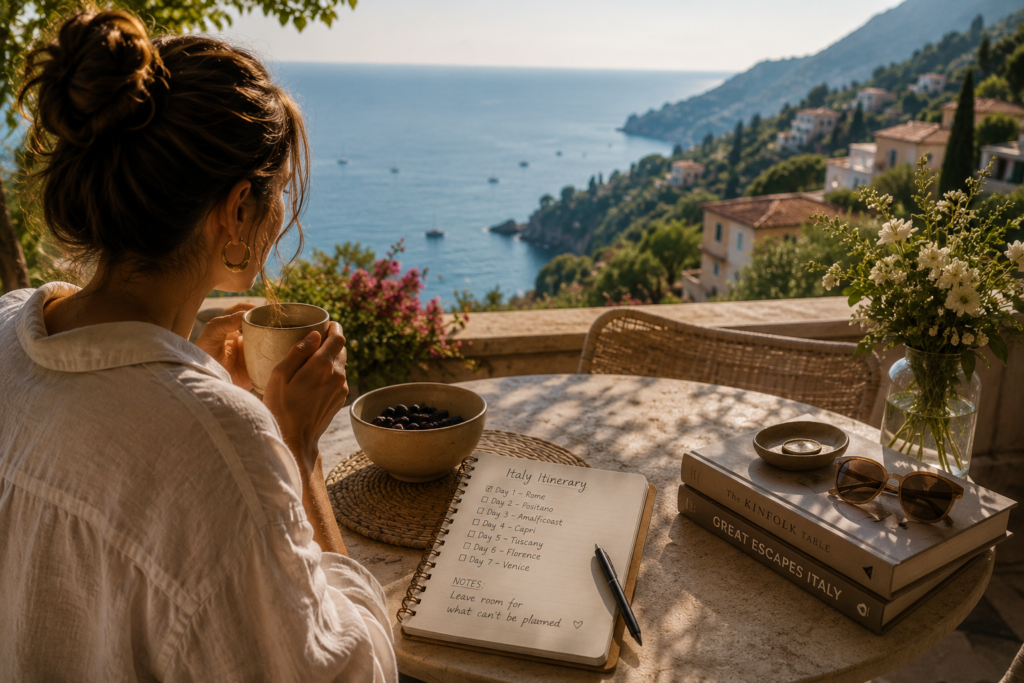
Why your perfect travel itinerary never feels quite the same in real life?
At some point, typically several weeks out from a trip, the travel planning begins to teeter on the brink of absurdity.
You have the flights. The hotel is booked. Then you realize that the museum you’re planning to visit requires a reservation, so you reserve that too. An interesting restaurant catches your eye, so you save it. On Instagram, somebody recommends a viewpoint over on the other side of town. Google Maps says it is only a 28-minute trip.
Why not?
In no time, Tuesday boasts a 9:00 a.m. museum reservation, lunch at 12:15, a walking tour at 1:30, a neighbourhood to discover by 4:00 and dinner scheduled for 7 o’clock.
It looks great on screen.
This may even be the most organized holiday you’ve planned in your life.
Then Tuesday actually arrives.
The museum takes longer than expected. Lunch is late. You walk farther than you expected. The weather changes. You miss a turn. Somebody wants coffee. Someone else wants to sit down.
Suddenly, the gorgeous itinerary seems less like a travel plan and more like an appointment calendar you are already falling behind on.
Travel planning is strange like that. You spend a lot of time thinking about where you want to go and not much time thinking about what it will feel like getting there.
That is where the plan normally gets derailed.
A Map Doesn’t Take Into Account That You’re Tired
Many route planners are excellent at letting you know that somewhere is 1.8 kilometres away.
They don’t know that you have just walked 14 kilometres.
They don’t know that the road is steep as a cliff face. They’re unaware that you stopped for photos. They have no idea you woke up at 4:30 a.m. to get there because your flight arrived at dawn.
A map measures distance. Travelers experience effort.
The difference matters.
This is why an itinerary made up of stops that seems perfectly logical at home can sometimes feel utterly ridiculous in person. We calculate travel time in minutes but forget to measure it in energy.
A trip to the museum doesn’t end after two hours inside. There’s getting there, finding the entrance, waiting, walking on to eat somewhere afterwards and finally getting back out onto the street.
Do that three or four times in one day, and even those supposedly short distances start adding up.
When you’re planning your travel, there is a less obvious question you should ask yourself about every activity:
How will I feel after doing this?
That answer is more useful than the distance on a map.
Stop Trying to Win Your Destination
Another reason people over-plan.
They want to feel like they got their money’s worth.
After travelling halfway around the world, you should see all the good bits, right? If you’ve invested four nights in Paris, why would you waste an afternoon doing virtually nothing?
That sounds reasonable until you remember a holiday is not an exam.
You don’t get more for seeing 19 attractions instead of, say, 12.
And there are odd traps when you try to “complete” a destination. When visiting places turns into a checklist, we can remember the logistics better than the place itself.
In major cities, this is, to me, a particularly easy thing to do. Someone else always wants you to see another landmark, visit another market, go to another neighbourhood they insist you simply must not miss.
You can miss some of them.
The city will still be there.
Even more importantly, you might find that the café where you stopped because you were tired becomes one of your clearest memories. Perhaps you spend an hour people-watching in a square rather than racing off to the next attraction.
That isn’t wasted time.
It is time spent actually being somewhere.
Prioritize Each Day, Don’t Deadline It
I’m definitely not saying, “Plan less, traveller sensei.”
Quite the opposite.
There are simply some things that should be booked. Popular attractions sell out. Trains leave at particular times. Ferries don’t wait for you because you found a quaint bakery. Sure, if there is one restaurant you’ve been waiting months to get into, book it.
The challenge lies in determining what warrants such a commitment.
One helpful way to understand your day is to select one thing you would be truly sad to miss.
That’s your anchor.
Everything else can cruise around it.
Don’t follow an anchor like a morning hike with three other major activities right afterwards just because they’re next to each other. If it is a special dinner, don’t waste the day travelling out to the other side of town and back.
Leave the day somewhere to breathe.
It also makes it a lot easier to cope with sudden changes. You know what counts if your morning runs late. You don’t have to rescue an entire spreadsheet of reservations.
Arrival Day Receives More Mercy Than It Deserves
Arrival days are routinely underestimated.
However, a flight with a landing time of 8:00 a.m. looks like money on paper. You’ve got the whole day.
In reality, there is the immigration line, gathering your bags, transport to the hotel, checking in, disorientation and that half-day of body-clock misalignment with local time.
Sometimes everything goes beautifully.
Other times the airport has other plans.
And this is why I don’t recommend putting your most important experience on arrival day. If it’s something that could easily be moved to another day, think twice before putting it there.
Your first afternoon can be deliberately low-key.
Have lunch. Walk around the neighbourhood. Find a supermarket. Sit somewhere outside. Get an early dinner.
You may be feeling ready to do more.
If you do, great. There is going to be a ton of stuff to do.
Make a Plan B, but Don’t Make Plan C to Z

When coping with uncertainty, some travelers will sometimes prepare even more.
Bad weather? They have six alternatives.
Restaurant closed? Four more saved on the map.
Train cancelled? They have looked at three other routes.
For only so long does that backup plan stay a standby itinerary.
Usually, one sensible alternative is enough.
Plan for a rainy day if an outdoor activity is the focus of your day. If you’re going somewhere where plans can be affected by the weather, account for one flexible day. Know the next best option if that connection is important to you.
Then stop researching.
There is a fine line between being prepared and trying to eliminate every potential inconvenience before leaving your house.
The second one is exhausting.
And, weirdly, when something goes wrong, it actually makes it harder for you to adapt.
Leave Some Things Undecided
And years laterThis is likely the hardest advice for people who actually like to plan.
Don’t book everything.
It could mean leaving a restaurant or an afternoon open. Mark a couple of places down and leave the in-between part blank for as long as you can.
You may change your mind.
That’s the point.
Maybe the district you thought would be full of interest is simply not your scene. Or maybe you find a whole other part of the city that you like a zillion times better. Maybe a local, one of the people who actually calls that little bit of the world home, recommends somewhere you’ve never even heard of.
That isn’t compatible with a completely fixed itinerary.
And a lot of the best travel decisions are made once you’re there.
You spot a street that you’d like to follow. You see a sign for a market. Your hotel receptionist tells you about a tiny restaurant. You strike up a conversation with someone on a train who proposes another route.
Those moments are not something you can research into being.
You need to make space for them.
A Two-Hour Rule Can Spare You a Day
One little planning trick that seems to matter more than it should: don’t assume an activity ending at 2:00 is soon enough for you to be somewhere else at 2:15.
Allow yourself more time than the map says you need between key commitments.
The extra time gets used.
Almost always.
Maybe you stop for coffee. Maybe the queue is longer. Or perhaps you’re unable to locate the entrance. Maybe, in this unfamiliar place, you just walk slower.
Travel, it seems, has a way with empty minutes.
If it matters, give it a buffer.
Not being able to take a picture is one thing. Missing a train is another.
Perhaps the Best Part of the Trip Was the Part You Didn’t Design
This is where travel planning starts to get a little bit ironic.
Planning is not meant to dominate the entire trip.
It is meant to help you make enough decisions in advance that you don’t have to make them all while you’re there.
Know where you’re sleeping. Know how you’ll get there. Only book the stuff that actually requires booking. Understand the distances. Give yourself realistic time.
Then loosen your grip.
You don’t have to know what you’re doing on Thursday at 3:17 p.m.
It’s unnecessary to even know if Thursday ends up being your favourite day.
You change when you’re inside a trip. Weather changes. Energy changes. Prices change. People change their minds. Physically, an area can look completely different from how it appeared in a hundred separate pictures.
That is not a failure to plan.
It is travel.
So allow the things that make up a good itinerary to hold the important bits of the trip, while being loose enough to survive everything else.
Because the itinerary is more than likely going to break somewhere down the road.
Your train may be late. Your restaurant may disappoint you. You might spend two hours somewhere you thought you’d spend twenty minutes. You might skip the attraction everyone told you that you absolutely had to see.
And years later, you might remember that Saturday afternoon as the part where the trip really began.
Your good itinerary won’t save you in those moments.
It leaves room for them.
Perhaps That’s the Real Point of Planning a Trip
You plan enough to know where you’re going.
You leave enough space to discover where you end up.
How About Your Next Trip?
Before filling every hour of the itinerary, leave a little room for something you haven’t planned. You might be surprised by what ends up becoming the part you remember most. And if you’ve ever had a carefully planned day turn into something completely different, that’s probably a travel story worth sharing.
Recommended



Are you a traveler, blogger or writer with a story to share?
You can write for Travelazz to educate and inspire adventurous explorers worldwide.

No Comments